 Skip to content


Table of Contents
- How Keyless Entry Systems Fail as Cars Age
- Common Keyless Entry Problems in Older Vehicles
- What Decides the Cost of Keyless Entry Repair
- Repair or Replace: Comparing the Options for an Older Car
- What an Automotive Locksmith Keyless Entry Repair Visit Involves
- How Keyless Entry Repair Affects Vehicle Security
- When Repair Is Worth It and When It Is Not
- Frequently Asked Questions
Last Updated: September 23, 2026
How Keyless Entry Systems Fail as Cars Age
Keyless entry repair on an older car is usually worth it when the fault is mechanical or electronic rather than a failed control module, and the vehicle is otherwise sound. Most failures trace back to a handful of predictable components, which is why diagnosis matters more than the age of the car itself.
Keyless entry is the system that lets a driver unlock and start a vehicle without physically turning a key, using a fob that communicates with a receiver in the car. Over time, that communication chain weakens.
At EBM Auto Keys, we’ve spent 18 years in the motor trade watching the same patterns repeat. Fobs wear out. Receivers corrode. Wiring chafes where it passes through the door loom. None of that is unusual, and none of it is a reason to scrap a car.
The important distinction is between a component that has failed and a system that has been neglected. A worn fob button costs little to sort. A corroded module buried under a seat takes longer. Both are fixable. What matters is knowing which one you’re dealing with before you commit to anything.
That’s the throughline for this guide: the decision isn’t really about the car’s age. It’s about whether the fault sits in a cheap, accessible part or an expensive, buried one.
Common Keyless Entry Problems in Older Vehicles
The most common keyless entry problems in older vehicles are failing fob batteries, worn fob buttons, water ingress into door or boot wiring, and corroded receiver contacts. Most are repairable without replacing the whole system.
Fobs That Stop Talking to the Car
A fob that works intermittently is usually the cheapest possible fault to fix. Batteries fade, buttons lose their tactile click, and the internal contacts oxidise from years of pocket lint and moisture.
What most guides miss is that a fob can fail in two different ways. The battery dies, which is simple. Or the fob’s circuit board loses its pairing with the car, which needs reprogramming rather than a new battery. Those two problems look identical from the driver’s seat.
If your fob only works when you’re standing right next to the door, that’s a signal problem, not a power problem. It usually means the receiver is struggling, not the fob.
Water Ingress and Wiring Faults
Water is the quiet killer of keyless systems on older cars. Door looms flex every time the door opens, and after a decade that flexing cracks the insulation. Once moisture gets in, contacts corrode and signals stop arriving.
Boot and tailgate wiring suffers the same fate, often worse on vans and estate cars where the tailgate gets heavy use. A recovery truck that’s opened and closed hundreds of times a year will show this long before a low-mileage hatchback.
The giveaway is a system that works in dry weather and fails after rain. That pattern points straight at water ingress, and it’s a repair an automotive locksmith keyless entry repair visit can often trace on site.
What Decides the Cost of Keyless Entry Repair
Cost is decided by four things: how deep the faulty component sits, whether parts are still available, who does the work, and how much diagnostic time the fault needs. None of these relate directly to the car’s age.
Vehicle Age, Make and Parts Availability
Older, high-volume models often have better parts availability than newer, low-volume ones. A common van or family hatchback from fifteen years ago may still have plentiful fob shells, receivers and wiring looms. An obscure import from eight years ago may not.
This is the part that surprises people. Age alone tells you very little. What matters is whether the manufacturer built enough of them for the aftermarket to care.
Where a part is genuinely unavailable, a specialist can sometimes repair the original unit or source a compatible replacement rather than declaring the system dead. That route is often cheaper than a main dealer would suggest.
Dealership Versus Independent Repair
Dealerships work to a replace-first approach. If a module is suspect, it gets swapped, and the labour is charged at main dealer rates. That’s not dishonesty, it’s how their systems are built.
Independent specialists work the other way. They diagnose first, repair what’s actually broken, and only replace when repair isn’t viable. For an older car, that difference is usually the whole decision.
EBM Auto Keys provides a mobile service across the region, which removes the recovery cost of getting a non-starting vehicle to a garage. For a van that’s off the road, that alone can matter more than the repair itself.
| Factor | Pushes Cost Up | Pushes Cost Down |
|---|---|---|
| Fault location | Buried module, dash or floor | Fob, door loom, accessible wiring |
| Parts availability | Rare import, discontinued unit | Common model, aftermarket support |
| Provider | Main dealer, replace-first | Independent, repair-first |
| Access | Immobilised, cannot be moved | Drivable, mobile call-out possible |
| Diagnosis | Intermittent fault | Consistent, reproducible fault |
Repair or Replace: Comparing the Options for an Older Car
Repair almost always beats replacement when the car is otherwise reliable and the fault is confined to the keyless system. Replacing a car to solve a fob or wiring fault is rarely a rational financial decision.
Here’s the honest comparison. Repairing keeps a vehicle you already know, with a maintenance history you understand. Replacing means a new set of unknowns, plus the depreciation hit on whatever you buy.
The case for replacement only becomes strong when the keyless fault is one of several expensive problems stacking up. If the gearbox is tired, the suspension is knocking and the keyless system has failed, you’re not really deciding about keyless entry anymore.
There’s also a middle path that gets overlooked: repairing the keyless system now and planning the vehicle’s replacement on your own timeline, rather than being forced into it by a car that won’t start.
Before deciding, ask for a diagnosis rather than a quote. A diagnosis tells you what’s actually failed. A quote without one is guesswork, and on older cars that guesswork usually costs more than the diagnosis would have.
What an Automotive Locksmith Keyless Entry Repair Visit Involves
A mobile keyless entry repair visit starts with on-site diagnosis, then moves to repair or reprogramming, and finishes with testing across all fob functions. Most visits are completed in a single appointment.
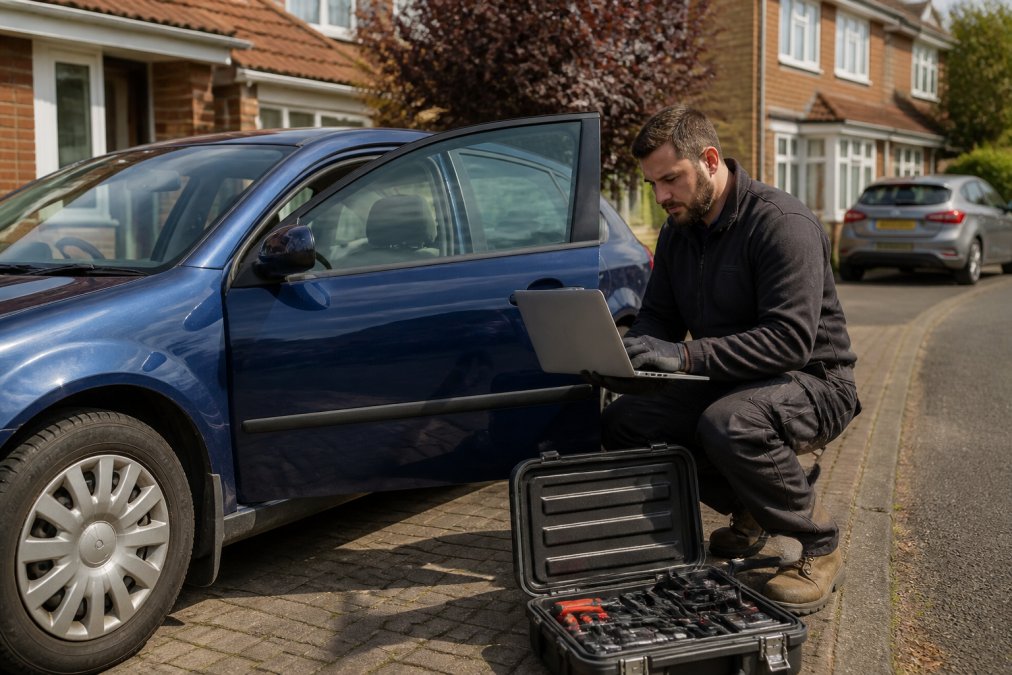
The sequence typically runs like this:
- Confirm the fault and rule out a flat fob battery
- Test signal strength between fob and receiver
- Inspect door, boot and tailgate wiring for water damage
- Check the receiver and module connections
- Repair or replace the faulty component
- Reprogram or re-pair the fob to the vehicle
- Test lock, unlock, boot release and start functions
How Keyless Entry Repair Affects Vehicle Security
Avoid any provider who offers to bypass or disable an immobiliser to get a car running. It may start the vehicle, but it can void your insurance and leave the car far easier to steal.
For fleet operators, this matters beyond a single vehicle. A compromised security system on one van is a weakness that affects the whole yard’s risk profile. Doing the repair properly the first time is the cheaper option over any realistic timeframe.
When Repair Is Worth It and When It Is Not
Repair is worth it when the fault is a fob, wiring or accessible component, and the car is otherwise dependable. It is not worth it when the keyless failure is the latest in a long line of expensive faults.
Work through this honestly:
- Is the fault confined to the keyless system, or part of a wider pattern?
- Is the vehicle otherwise reliable and safe?
- Are replacement parts available, or can the original be repaired?
- Would repairing it buy you at least another year or two of use?
- Is the car worth more to you running than it would be sold faulty?
For most older cars, a keyless entry fault is a repair decision, not a replacement decision. The exception is when the fault sits alongside several other expensive problems, in which case it’s a signal about the vehicle, not the system.
Frequently Asked Questions
How do I know if my keyless entry system is failing?
The usual signs are a fob that only works when you stand right next to the car, buttons that need pressing several times, or the vehicle failing to recognise the fob at all. Some drivers notice the central locking cycling on its own or the interior lights staying on. If two fobs behave the same way, the fault is more likely in the car’s receiver or wiring than in the fob itself, so it is worth having the system tested before buying replacements.
Is it cheaper to repair a keyless remote or replace the whole system?
Repairing or reprogramming an existing remote is almost always the lower-cost route, because the receiver, wiring and actuators are left untouched. Replacing the whole system only makes sense when the receiver or control module has failed and replacement parts are no longer available. A diagnostic check confirms which parts have actually failed, so you are not paying to replace components that still work. Pricing depends on the vehicle and the parts required, so ask for a quote before work starts.
Can an automotive locksmith fix factory-fitted keyless entry?
Yes. An automotive locksmith keyless entry repair covers factory-fitted systems as well as aftermarket kits, including fob programming, receiver faults, wiring repairs and actuator replacement. The advantage over a dealership is that a mobile locksmith comes to you, which matters if the car cannot be driven or the fob has stopped working entirely. Complex immobiliser faults are best confirmed by diagnosis first, so you know whether a repair is viable before committing.
Does repairing a keyless system improve vehicle security?
A working keyless system is more secure than a faulty one. When central locking fails, owners often leave doors unlocked or rely on a single mechanical key, which increases the risk of theft. Repairing the fault restores the locking behaviour the car was built with, and worn fobs or damaged receivers are fixed at the same time. If you are unsure whether a fault has affected your security, ask for the system to be checked alongside the repair.
