 Skip to content


Last Updated: November 12, 2026
Quick Summary
To protect car key signals from relay theft, keep your key fob inside a signal-blocking Faraday pouch whenever it is at home or in the car. Keys left near doors or windows are most exposed, so store them in a closed drawer away from entrances. Test your pouch with your own vehicle every few months to confirm it still blocks the signal.
- Relay attacks capture the weak signal from your fob, even when it is inside your house.
- A Faraday pouch blocks the fob signal only while the fob is fully sealed inside it.
- Test your pouch by checking the car does not respond with the fob sealed inside.
- Retest every three to six months, and after any drop, crush or wash.
- Pair signal protection with physical deterrents such as a steering wheel lock.
Table of Contents
- How Keyless Car Theft and Relay Attacks Work
- Choosing a Faraday Pouch for Car Keys
- How to Test a Faraday Pouch Before You Rely On It
- Where to Keep Car Keys at Home
- Turning Off Wireless Signals on Your Key Fob
- Physical Deterrents and Other Ways to Secure a Keyless Vehicle
- Keyless Car Theft Prevention Routine for Your Household
- Booking a Key Security Check With EBM Auto Keys
- Frequently Asked Questions
How Keyless Car Theft and Relay Attacks Work
Keyless cars are easy to open and start, and that convenience has created a theft method that does not need a broken window or a stolen key. Thieves use relay attacks to pick up the signal from your key fob, even when the fob is inside your house, and copy it to unlock and start your car (Keyless car thefts warning).
A relay attack uses two people with two devices. One thief stands near your front door or parked car and captures the weak signal your fob sends out. The second thief stands near your car and repeats that signal to the vehicle.
- The fob does not need to be touched or stolen
- The attack can take only seconds
- Signal boosting devices make the range longer
- Keys left near doors, windows or hallways are most exposed
Many owners only learn about relay theft after it happens. Knowing the basics helps you spot the risk early and choose the right protection.
Choosing a Faraday Pouch for Car Keys
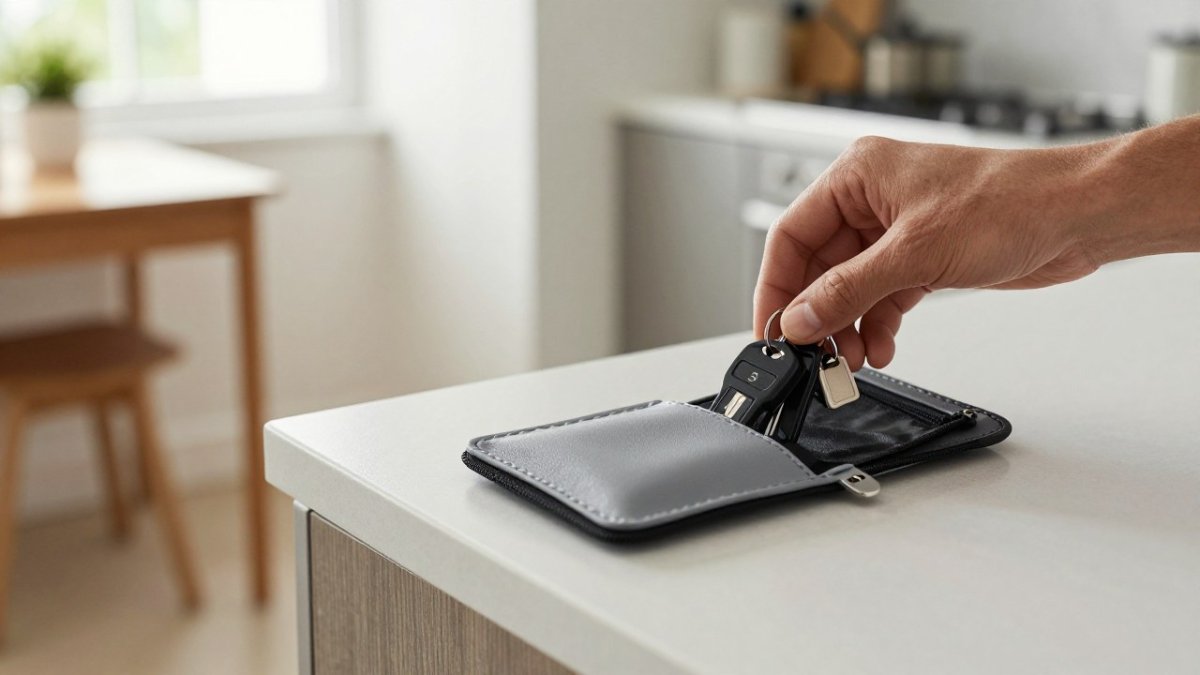
A Faraday pouch is a bag lined with metal mesh or foil that blocks radio signals (Protect your car from theft). When you put your key fob inside, it cannot send its signal out, which stops relay attacks. Pouches vary widely and not every pouch will block every fob.
What to look for
- A fully enclosed design with a tight zip or seal, and a flap that folds over the closure
- Metal mesh or conductive lining that covers all sides, including the base and the zip line
- A size that fits your fob, including larger fobs and smart cards, without stretching the lining
- Reinforced stitching at the seams, which is where linings usually fail first
Pouches, boxes and wallets compared
| Type | Typical use | Strengths | Limitations |
|---|---|---|---|
| Pouch | Carrying in a pocket or bag | Portable, low cost, easy to use daily | Lining and zip wear with use; needs regular retesting |
| Box or tin | Home storage | Rigid, harder to damage, holds several fobs | Bulky, not portable, seal can loosen over time |
| Wallet or sleeve | Everyday carry | Slim, fits in a pocket | Less padding, lining can crease |
A rigid box can suit the home routine while a pouch or wallet suits daily carry, and some households use both. There is no single best product, only the one that fits how you actually use your keys.
Compatibility and limitations
Fobs and vehicles differ in frequency and signal strength, so a pouch that works for one car may not block another. Poorly made or damaged pouches can let a signal through even when the fob is sealed inside, and a pouch only works while the fob is inside it and fully closed. Never assume protection: verify it with the vehicle test described in the next section, and retest after wear or damage.
Ongoing costs and durability
Pouches are inexpensive to buy but are consumables rather than lifetime purchases. Expect to replace one when the zip stiffens, the lining creases or a retest fails, and budget for that as part of running a keyless car. Physical deterrents such as a steering wheel lock are a durable complement to signal protection, so combining a regularly replaced pouch with a physical measure is a sensible approach.
!A set of car keys being slid into a grey signal-blocking pouch on a kitchen worktop beside a hallway table
How to Test a Faraday Pouch Before You Rely On It
A pouch is only protection if it actually blocks your fob, and the only reliable way to know is to test it with your own vehicle. A pouch that passes on day one can fail months later once the lining creases, the zip loosens or the seams wear, so treat testing as a recurring check rather than a one-off.
The vehicle test
- Park the car and keep the fob at least a few metres away from it, in the open, so you have a clear baseline.
- Press the unlock button with the fob in your hand. The car should respond. If it does not, move closer or fit a fresh battery before going further, because a flat fob will give you a false pass.
- Place the fob inside the pouch, close the zip or seal completely, and fold the flap over if the design has one.
- Stand in the same spot and press the unlock button through the pouch. The car should not respond at all.
- Take the fob out and press again. The car should unlock, confirming the fob and car are working normally.
- Repeat steps 3 to 5 two or three times. A pouch that blocks intermittently is not reliable.
How to read the result
- Car does not respond with the fob sealed inside, and does respond when removed: the pouch is blocking the signal and is fit for use.
- Car responds with the fob sealed inside: the pouch is not blocking your fob’s frequency or the seal is incomplete. Do not rely on it.
- Car does not respond in either case: the fob battery is likely low or the fob is faulty. Replace the battery and retest before judging the pouch.
- Car responds only sometimes: the lining or zip is probably damaged. Retire the pouch.
Watch out: a pouch that passes with one fob may fail with another, because fobs and vehicles differ in frequency and power, so test every fob you carry, including spares, individually.
When to retest
Retest after any of the following:
- Every three to six months as a routine check
- After the pouch has been dropped, crushed in a bag or washed
- When the zip, seal or stitching starts to look worn
- When you change your fob battery or replace a fob
Keep a note of the date of each test so you can see how the pouch is ageing. A pouch that has protected you for a year is not guaranteed to protect you in year two, and the cost of replacing it is small compared with the cost of a stolen vehicle.
Where to Keep Car Keys at Home
Where you keep your keys matters as much as the pouch you use. Keys left near the front door, in a hallway bowl or on a hook close to a window are easier for thieves to reach with a relay device.
A simple home routine helps:
- Keep keys in a closed drawer or cabinet away from doors and windows
- Put the fob in a signal-blocking pouch every night
- Do not leave keys near the front door or a window at any time
- Store spare keys separately and in a secure place
If you are unsure which spot is safest, pick the place furthest from the entrance and from any outside wall. Then make it the same spot every day so you never have to think about it.
Turning Off Wireless Signals on Your Key Fob
Some keyless systems let you reduce the signal your fob sends. Options vary by manufacturer and model, so check your car handbook or the dealer’s guidance for your exact vehicle.
Common options include:
- Turning off passive entry so the car does not unlock as you approach
- Disabling keyless start if your car offers the setting
- Switching the fob to a lower-power mode where available
- Removing the battery from a spare fob you do not use
Be careful with these changes. Turning off passive entry makes everyday use slightly less convenient, so only do it if the trade-off makes sense for you. Some fobs also have a mechanical key blade you can use as a backup if the battery fails.
Physical Deterrents and Other Ways to Secure a Keyless Vehicle
Signal protection works best alongside other measures. Physical deterrents are useful because they stop a thief even if they have copied your signal.
- A steering wheel lock makes the car harder to drive away
- A visible immobiliser or alarm discourages opportunistic thieves
- A tracker helps you locate the car if it is taken
- Parking in well-lit, busy places reduces risk
You can also ask a professional about the immobiliser system fitted to your car.
Keyless Car Theft Prevention Routine for Your Household
Protection is strongest when everyone in the household follows the same habits. You can find more ongoing guidance on car key security on the EBM Auto Keys blog. Set up a routine that is easy to remember and easy to share.
- Every night, place every fob in a signal-blocking pouch
- Keep the pouch and spare keys in one agreed spot
- Check the car is locked after each trip
- Test your pouch every few months, or when you replace it
- Review your parking and garage habits each season
A routine stops keys from being left out by mistake, which is the most common gap in home protection. Once it becomes a habit, it takes almost no effort.
Booking a Key Security Check With EBM Auto Keys
If you are unsure whether your keys or vehicle are protected, a professional check gives you clear answers. EBM Auto Keys is a local automotive locksmith covering South Wales and nearby areas. Our team has 18 years of motor trade experience and offers a 24/7 emergency call-out service, so help is available when you need it.
We can inspect your key set, check your immobiliser and advise on the right protection for your vehicle. You can explore the full range of automotive locksmith services we offer, from key replacement and programming to repairs. When you are ready to arrange a check, contact EBM Auto Keys to make an enquiry or book a visit.
Protect your car key signals today: contact EBM Auto Keys to arrange a key security check that keeps your vehicle safe on the road.
Frequently Asked Questions
Do signal-blocking pouches work for car keys?
Many do, but results depend on the pouch’s construction and how well it is sealed. A pouch should fully enclose the fob, with no gaps at the seams or fastening, and it should be checked with the test described in this guide rather than trusted on the packaging alone. Pouches also lose effectiveness if they are worn, torn or overfilled, so inspect them regularly and replace any that show damage. No product removes every risk, so combine a pouch with sensible storage habits at home and on the road.
Can a metal tin block a car key signal?
A closed metal tin can block some signals, but it is not a reliable substitute for a purpose-made pouch. The lid often has small gaps, the metal may be thin or coated, and a tin that has been opened or dented may let signals through. If you use one, test it with the same method as a pouch, keep the fob in the centre and check that the lid closes fully before you rely on it.
Where should I keep my car keys at home?
Keep keys in a single, consistent place away from the front door, a window or the hallway where they can be reached through a letterbox or glass. A drawer, cupboard or lockable box inside a room is a better choice. If the fob is in a signal-blocking pouch, store the pouch in that same place so the habit stays simple. Avoid leaving keys on a hook by the door, because a passing thief only needs to be close to the house to attempt a relay.
Should I switch off my keyless car key when it is not in use?
Where your vehicle or fob allows it, turning off wireless functions when the car is parked and the key is at home can reduce exposure. Not all fobs have this option, and some manufacturers use battery-saving modes instead of a simple switch, so check your owner’s manual or ask your dealer or locksmith which settings apply to your model. Where switching off is not possible, a Faraday pouch remains the practical alternative.

