 Skip to content


Last Updated: October 25, 2026
Quick Summary
You prevent key theft by enforcing a written key control policy: every key tagged and signed out to a named holder, spares sealed in a steel cabinet, and lost keys reported the same day. Relay attacks and keys left in vehicles are the main routes thieves use.
- Relay attacks stretch the key signal from inside a building to the van outside.
- Seal the spare set in a signed envelope so a broken seal shows a key was used.
- Report stolen van keys to the police first and get a crime reference number.
- Reprogramming the immobiliser is the only way to make a stolen fob useless.
- Anchor the key cabinet into masonry, never plasterboard, and keep it out of sight.
Table of Contents
- Why Commercial Vehicle Key Theft Is a Growing Risk
- Building a Vehicle Key Control Policy That Works
- Fleet Key Management: Who Holds Which Key
- Choosing a Secure Key Cabinet for Fleet Use
- What to Do If Van Keys Are Stolen
- Common Mistakes That Make Key Theft Easier
- Getting Your Fleet Keys Replaced and Secured
- Frequently Asked Questions
Why Commercial Vehicle Key Theft Is a Growing Risk
Key theft is now one of the simplest ways a van disappears from a depot. Thieves rarely force a lock anymore. They take the key, or they capture its signal, and drive away with no damage and no alarm.
The reason is the technology itself. Modern vans rely on a transponder chip and immobiliser to start. If you want to understand how that system works, our guide on what a transponder key immobiliser system is explains the basics clearly.
Two methods dominate:
- Relay attacks. Two people work as a pair. One stands near the key inside a building, the other near the van. The signal is stretched between them and the van unlocks.
- Key-on-key crime. Spare keys left in a drawer, a hook by the door, or a glovebox. No tool needed.
Watch out: a van stolen this way often has no forced entry, so insurers ask hard questions about key custody. That is why the paperwork matters as much as the lock.
Building a Vehicle Key Control Policy That Works
A vehicle key control policy is a written set of rules covering who holds each key, how it is issued, how it is returned, and what happens when one goes missing. Without it, key custody becomes guesswork.
Start with these rules:
- Every key gets a unique tag and a named holder.
- Sign-out and sign-in are logged, with times.
- No key leaves the site overnight without written authorisation.
- Spare keys live in a locked cabinet, never in a vehicle.
- Lost keys are reported the same day, not when someone remembers.
The last point matters most. A missing key that sits unreported for a week is a free pass for anyone who finds it. Our article on the benefits of spare car key duplication covers how a controlled spare programme fits into a policy like this.
Keep the policy to one page. A long document gets ignored; a short one gets followed.
Fleet Key Management: Who Holds Which Key
Fleet key management is the daily practice of tracking every key against every vehicle and every driver. The question to answer is simple: if a van moves at 3am, who signed for that key?
A practical structure looks like this:
| Role | Holds | Responsibility |
|---|---|---|
| Driver | One vehicle key | Signs out and back each shift |
| Depot supervisor | Master set | Issues keys and checks the log |
| Fleet manager | Spare set, sealed | Opens only for loss or breakdown |
| Office admin | No keys | Maintains the register |
The sealed spare set is the part most fleets skip. Seal it in an envelope, sign across the flap, and store it in the cabinet. If the seal is broken, you know a key was used and by whom. That single control catches more problems than any camera.
Rotate the register monthly and check it against the cabinet. A mismatch is a warning sign, not a clerical error.
Choosing a Secure Key Cabinet for Fleet Use
A secure key cabinet for fleet use should be steel, wall-mounted, lockable, and large enough that every key has its own numbered hook. Buy one size bigger than you need today.
What to look for:
- Steel body, at least 1.5mm thick, with a drilled and anchored fixing.
- A mechanical or digital lock, not a simple catch.
- Numbered hooks matched to your vehicle register.
- A log book slot so sign-out records stay with the cabinet.
- A tamper seal pack for the spare set.
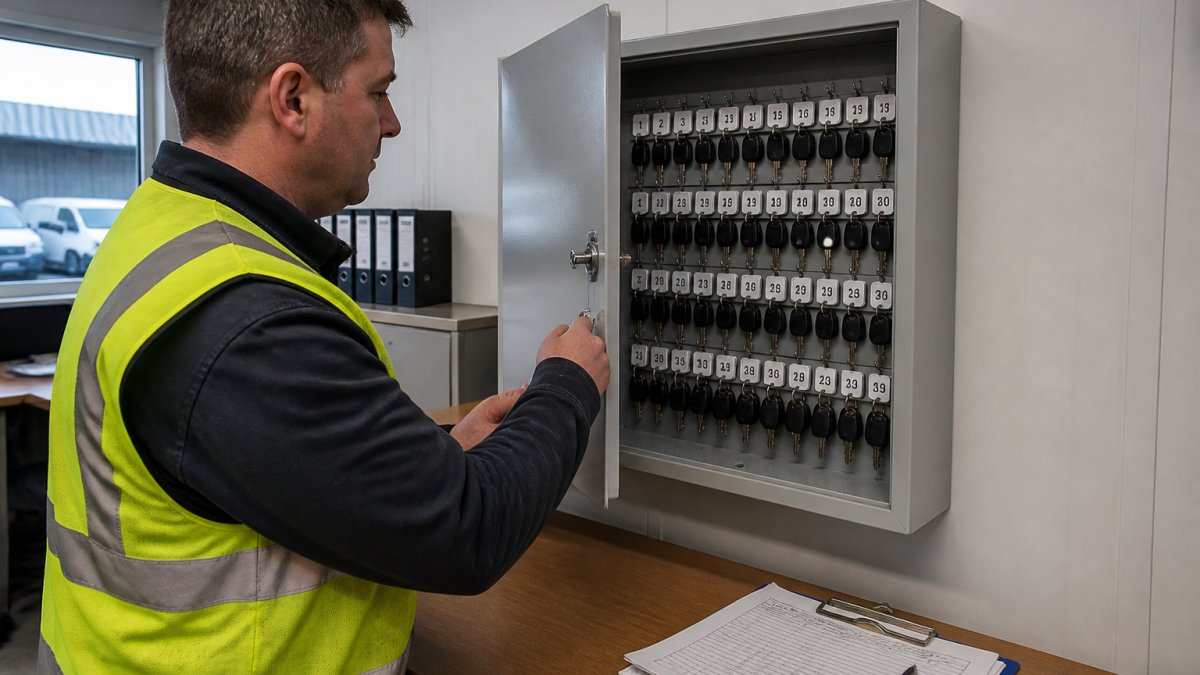
Where you put it matters as much as what you buy. Fit it in a room that locks, not a corridor. Keep it out of sight from a window. And never mount it where a visitor can read the vehicle numbers on the tags.
Watch out: a cheap cabinet screwed into plasterboard comes off the wall in seconds. Anchor it into masonry or a stud, and check the fixing holds.
What to Do If Van Keys Are Stolen
If van keys are stolen, report it to the police first and get a crime reference number. Then tell your insurer, and then get the vehicle’s locks and keys changed. Do not wait to see if the key turns up.
Work through it in this order:
- Report the theft and note the crime reference.
- Call your insurer the same day. Most policies expect prompt notification.
- Move the van to a secure location if it is still on site.
- Book a locksmith to change the lock and reprogramme the immobiliser.
- Update the register and record which key is now void.
A stolen key is not just a lost key. If the thief has the fob, the van will start. Reprogramming removes that fob from the vehicle’s memory, which is the only way to make it useless. If you need help urgently, you can contact our team and we will talk you through the next step.
Keep the crime reference safe. Insurers and locksmiths both ask for it.
Common Mistakes That Make Key Theft Easier
The biggest mistake is treating keys as an admin item rather than a security item. Most thefts we hear about trace back to a simple lapse, not a sophisticated attack.
The repeat offenders:
- Keys left in the ignition while loading or unloading.
- Spare keys kept in the van, often in the glovebox or under a seat.
- Fobs stored near the front door, within reach of a relay attack.
- No sign-out log, so nobody notices a key is missing.
- One person holding every key, with no oversight.
- Signal-blocking pouches bought but never used.
That last one is common. A pouch only works if the key goes in it every night, without exception.
A common mistake is buying security kit and assuming the job is done. The kit is half the answer; the habit is the other half.
Getting Your Fleet Keys Replaced and Secured
Replacement is where a bad week gets expensive, so plan it before you need it. A dealer visit usually means a recovery truck, a booking slot, and a long wait. Our guide to alternatives to dealership car key replacement sets out the other routes open to a fleet manager. A mobile auto locksmith can cut and programme a key on site, often the same day.
Our automotive locksmith services cover car key replacement, programming, repairs and emergency vehicle support across the region.
For a fleet, the sensible sequence is:
- Replace the compromised key and void the old one.
- Reprogramme the immobiliser so the stolen fob no longer works.
- Re-issue keys under the new register.
- Re-seal the spare set and log the change.
One more point on cost. Pricing depends on the vehicle, the key type and the work needed, so we quote after we know the details rather than guessing over the phone.
Frequently Asked Questions
How should a business store commercial vehicle keys securely?
Keep every key in a locked cabinet that only named staff can open, and log each key out and back in. A secure key cabinet for fleet use should be fixed to a solid wall in a room that is itself locked, not left in an open office or behind a reception desk. Avoid hanging keys on open boards or leaving them in vehicle lockers overnight, because both give a thief a quick grab-and-go opportunity with no forced entry needed.
What should a business do if a commercial vehicle key is stolen?
Report the theft to the police and get a crime reference number, then tell your insurer straight away. Move the vehicle to a secure location if it is still on site, and have the affected locks and keys dealt with by an automotive locksmith rather than waiting. If the key was a remote or transponder type, the vehicle’s immobiliser may need reprogramming so the missing key no longer starts it. Keep a record of the incident for your fleet file.
Can a spare vehicle key increase the risk of theft?
A spare key only raises the risk when it is stored badly. If the spare sits in the glovebox, a magnetic box under the wheel arch, or an unlocked drawer, a thief who gets into the vehicle can drive it away. Keep spares in the same controlled cabinet as the primary keys, tagged and logged, so you always know where every key is. That way a spare is a backup, not a second opportunity.
How often should a fleet review its key-control procedures?
Review your vehicle key control policy at least once a year, and again whenever a driver leaves, a vehicle is sold, or a key goes missing. Check that the key log matches the keys actually in the cabinet, that leavers have handed back everything, and that cabinet access is limited to current staff. A short quarterly spot check catches small problems, such as an unreturned key or a broken lock, before they become a theft.
Key theft rarely happens because a thief is clever. It happens because a key was left where it should not have been, and nobody was watching. If you run vans or recovery trucks and want the locks and keys sorted properly, EBM Auto Keys can help. With 18 years of motor trade experience, a 24/7 emergency call-out service and same-day availability, we handle key replacement, programming and immobiliser faults on site. Get started with EBM Auto Keys and close the gap before someone finds it.

