 Skip to content


Last Updated: November 2, 2026
Quick Summary
You can program spare car key yourself on many older vehicles with transponder or remote keys, usually in 20 to 30 minutes using an on-board ignition sequence and no special tools. Proximity and push-button-start vehicles cannot be done this way and need diagnostic programming by a dealer or locksmith.
- Check your owner’s manual for a key registration section before buying any blank key.
- The ON position is the second click, where dashboard lights come on but the engine does not crank.
- If a sequence fails twice, stop, as repeated attempts can trigger a temporary lockout.
- Spare key programming adds a new key, while a flat fob battery usually needs only resynchronisation.
- A new fob with a dead battery cell will not transmit, so check the cell first.
Table of Contents
- Can You Programme a Car Key Yourself?
- Step 1: Identify Your Key Type and Check Compatibility
- Step 2: Car Key Programming Tools and What You’ll Need
- Step 3: How to Programme a Car Key Fob Using On-Board Sequences
- Step 4: Test the Key and Fix a Car Key Not Recognised After Programming
- When DIY Programming Stops Working: Immobilisers and Push-Button Start
- Spare Key vs Reprogramming After a Battery Change
- Book a Spare Key Programming Visit
- Frequently Asked Questions
Can You Programme a Car Key Yourself?
Yes, you can programme a spare car key yourself on many older vehicles, usually in 20 to 30 minutes with no special tools.
The difference almost always comes down to one thing: whether your vehicle allows on-board programming at all.
On-board programming is the process of adding a new key to your car’s immobiliser using only the ignition, the pedals and the buttons already in the vehicle.
That matters because modern vehicles have locked this door. The DVSA guidance on vehicle identity checks is worth a read if you are buying a blank key, because a key cut to the wrong vehicle is useless.
Step 1: Identify Your Key Type and Check Compatibility
Before you buy anything, identify your key type. The three main types behave very differently, and only some support DIY programming.
- Transponder key: a plain key with a microchip in the head. No buttons. The chip talks to the immobiliser.
- Remote key fob: a transponder key with lock and unlock buttons built in.
- Proximity key: a fob you keep in your pocket. The car detects it and starts with a button.
Transponder and remote keys on older vehicles are the best candidates for on-board programming. Proximity keys rarely are.
Check your owner’s manual first for a section on key registration or key adding. If it describes a sequence of ignition turns, you have a route in.
If you are unsure whether your key carries a chip, our guide on what a transponder key immobiliser system is explains how the chip and reader work together.
Step 2: Car Key Programming Tools and What You’ll Need
Most DIY jobs need less than you would expect. The real requirement is a compatible blank, not a big toolkit. But the tools you need depend entirely on which of three programming routes your vehicle falls into, and getting that wrong is the most expensive mistake in this job.
The three programming routes
| Route | What it needs | Typical vehicles | DIY possible |
|---|---|---|---|
| On-board sequence | Working key, compatible blank, owner’s manual | Many pre-2015 vehicles with transponder or remote keys | Often yes |
| PIN or security-code entry | Working key, vehicle security code, compatible blank | Some mid-2000s to mid-2010s models | Sometimes, if you hold the code |
| Diagnostic programming | Manufacturer-level or locksmith-level diagnostic tool, security access | Most push-button-start and proximity vehicles, many post-2015 models | No |
Check your owner’s manual for a key registration section before buying anything. If it describes an ignition sequence, you are on route one. If it says “consult your dealer”, you are on route three and no amount of button-pressing will change that.
What to gather before you start
- A blank key or fob matched to your vehicle make, model, model year and immobiliser generation, not just the shape of the blade
- Key cutting for the blade, done by a locksmith or key cutter; a blank blade will not turn the lock
- Your existing working key, which acts as the master during programming
A common mistake is buying a blank without checking the microchip type. Two keys can look identical and carry different chips, and the car will reject an incompatible one.
If you only have one key and it fails mid-sequence, you can be left with a vehicle that will not start. Always programme the spare with a known working key present, and never run a sequence with your only key unless you have a recovery plan.
Realistic UK costs and when DIY stops making sense
Pricing depends on key type, vehicle and the programming route required, so contact EBM Auto Keys for a current quote. A diagnostic programming visit is a separate cost from the blank and cutting. The trade-off is simple: on route one, DIY saves the labour charge; on route three, buying a blank you cannot programme is money wasted. Confirm the blank matches your vehicle’s immobiliser generation before paying for cutting.
Step 3: How to Programme a Car Key Fob Using On-Board Sequences
On-board programming follows a fixed pattern on most vehicles that support it. The exact order varies by make, model, year and security system, so treat the sequence below as the logic rather than a universal script.
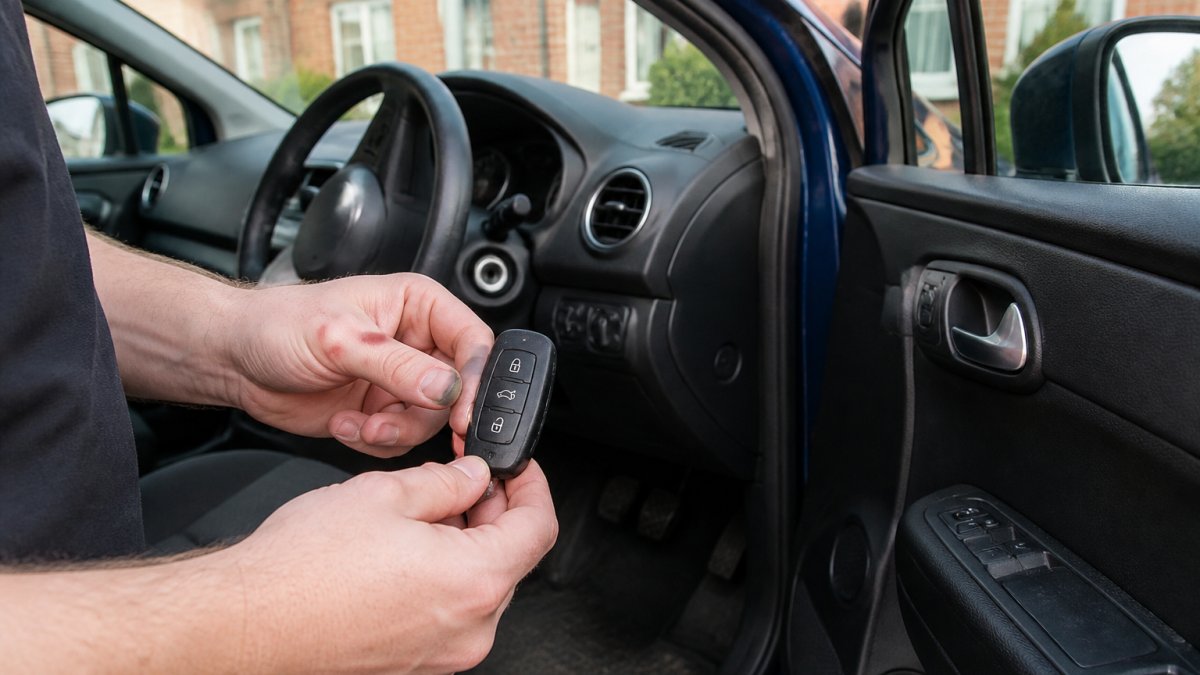
The general sequence runs like this:
- Sit in the driver’s seat with all doors closed.
- Insert your working key and turn the ignition to the ON position.
- Turn back to OFF, then repeat the cycle a set number of times within a time limit.
- Watch for a confirmation signal, such as a chime or a dashboard light.
- Press and hold a button on the new fob within the window the car allows.
- Wait for the confirmation signal, then switch off and remove the key.
- Repeat for any additional fobs, one at a time.
The ON position is the second click, where the dashboard lights come on but the engine does not crank. Getting this wrong is the most common failure point.
Ignition cycle and button press sequences
Timing decides whether the sequence works. Most vehicles give you a few seconds between each ignition cycle, and the whole procedure usually finishes inside a minute.
Because the variation is so wide, the table below groups the common patterns by security system rather than by individual model. Use it to identify which pattern your vehicle is likely to follow, then confirm the exact steps in your owner’s manual.
| Security system pattern | Typical sequence style | Confirmation signal |
|---|---|---|
| Basic transponder, older vehicles | Ignition on/off cycles, then insert new key | Chime or immobiliser light change |
| Remote fob with central locking | Ignition cycles plus lock/unlock button presses | Indicator flash or horn chirp |
| PIN-entry systems | Ignition cycles plus security code entry | Dashboard message or chime |
| Proximity and push-button start | No on-board sequence, diagnostic tool required | Not applicable |
Why modern immobilisers and push-button start break the sequence
This is the part most guides skip. On proximity and push-button-start vehicles, the fob and car use rolling security codes and a cryptographic handshake that on-board sequences cannot replicate.
The same limitation applies to some post-2015 vehicles even where a physical key is present, because the immobiliser generation changed. If your owner’s manual does not describe a registration sequence, assume diagnostic programming is required and do not buy a blank on the hope that a sequence exists.
Run every sequence parked and stationary, with the handbrake on and the vehicle off the public road. The Royal Society for the Prevention of Accidents road safety guidance is a useful reminder of why distraction and rolling vehicles do not mix.
If the sequence fails twice, stop. Repeated failed attempts can trigger a temporary lockout on some systems, and that lockout is exactly where a DIY job turns into a callout.
Step 4: Test the Key and Fix a Car Key Not Recognised After Programming
Test the new key immediately, before you put anything away. A car key not recognised after programming usually points to one of four causes.
- The sequence timed out. Repeat it from the start, moving faster between steps.
- The chip is wrong. The blank does not match your vehicle’s immobiliser generation.
- The battery is flat. A new fob with a dead cell will not transmit.
Try the new key in the ignition first. If the engine starts, the transponder is paired.
If the key turns but the engine will not fire, the immobiliser is rejecting the chip. Stop there. Repeated failed attempts can trigger a temporary lockout on some systems.
When DIY Programming Stops Working: Immobilisers and Push-Button Start
Some vehicles will never accept a DIY key, and it is better to know that before you spend money on a blank.
Push-button start and proximity systems are the clearest example.
The same applies to most vehicles with complex immobiliser and non-start faults.
Our automotive locksmith services cover key replacement, programming, coding and vehicle entry.
If you are weighing up a dealer visit, our comparison of alternatives to dealership car key replacement sets out what each route involves.
A common mistake is assuming a failed DIY attempt means a dead key.
Spare Key vs Reprogramming After a Battery Change
These are two different jobs, and mixing them up wastes time and money.
Spare key programming adds a new key to the vehicle. The car learns a new chip and stores it alongside the existing ones.
Reprogramming after a battery change restores a key that already belongs to the car. When a fob battery goes flat, the remote buttons stop working, but the transponder chip usually still starts the engine (Key fob not working? Here’s what to do).
Here is the split in practice:
| Situation | What is needed | DIY possible |
|---|---|---|
| New spare key, older vehicle | Add key via on-board sequence | Often yes |
| New spare key, push-button start | Diagnostic programming | No |
| Fob battery replaced, buttons dead | Resynchronisation | Usually yes |
| Fob battery replaced, engine will not start | Immobiliser diagnosis | No |
| All keys lost | Full key replacement and coding | No |
A flat fob battery is a frequent cause of confusion, and drivers sometimes buy a new key when a battery and a resync would suffice.
Having a spare ready before you need it avoids all of this. Our article on the benefits of spare car key duplication explains why a second key is cheaper than an emergency callout.
Book a Spare Key Programming Visit
DIY programming works on the right vehicle. On the wrong one, it costs you a blank key and an afternoon.
If your car has a proximity fob, a push-button start, or an immobiliser fault, the job needs proper equipment.
EBM Auto Keys also serves businesses running commercial vans and recovery trucks.
Get in touch with EBM Auto Keys to arrange a visit. Our contact page explains how to reach us with your questions, comments and feedback.
Frequently Asked Questions
Can you programmeme a spare car key yourself?
Sometimes, but it depends on the vehicle. Many older cars with a standard transponder or remote fob allow on-board programmememing using a sequence of ignition cycles and button presses described in the owner’s manual. Newer vehicles with proximity keys and rolling-code immobilisers usually need a diagnostic tool or a locksmith. Before buying a blank, check your model year and key type, because a blank that is not compatible will never pair no matter how carefully you follow the sequence.
Can you programmememe a car key with a code reader?
A basic fault code reader cannot programme a key. You need a diagnostic tool or key programming device that supports your vehicle’s immobiliser system and, in most cases, a security code for that vehicle. Even then, some systems lock programming behind dealer-level access. If you are buying car key programming tools for a one-off job, compare the cost of the tool against a locksmith call-out, because the tool may only work on a narrow range of models.
Why is my car key not recognised after programmememing?
The most common causes are a flat or incorrect key-fob battery, a blank that is not compatible with the vehicle, a programmememing sequence that timed out, or a second key still needed to complete pairing. Try a fresh battery first, then repeat the sequence from the start with the doors closed and all steps within the time limit. If the key still will not start the car, stop repeating the process and have the immobiliser checked, as repeated failed attempts can add to the fault.
How long does it take to programmememe a spare car key?
An on-board sequence for a compatible vehicle often takes 20 to 30 minutes including testing. A locksmith can often programmememe a new transponder or proximity key the same day, depending on availability. Jobs involving all keys lost or complex immobiliser faults take longer because the vehicle needs diagnostics first. If you are booking a visit, tell the locksmith your make, model and year so the right equipment and blank are brought along.
A lost or rejected key should not cost you a day off the road. EBM Auto Keys provides mobile key programming, replacement and immobiliser diagnosis, backed by same-day availability and 24/7 emergency callout. We programme what DIY cannot and test every key before we leave. Get started with EBM Auto Keys and drive away with a key you can rely on.

